


National Geographic 1998 April
Publisher: National Geographic
Format: Paperback
ISBN: none
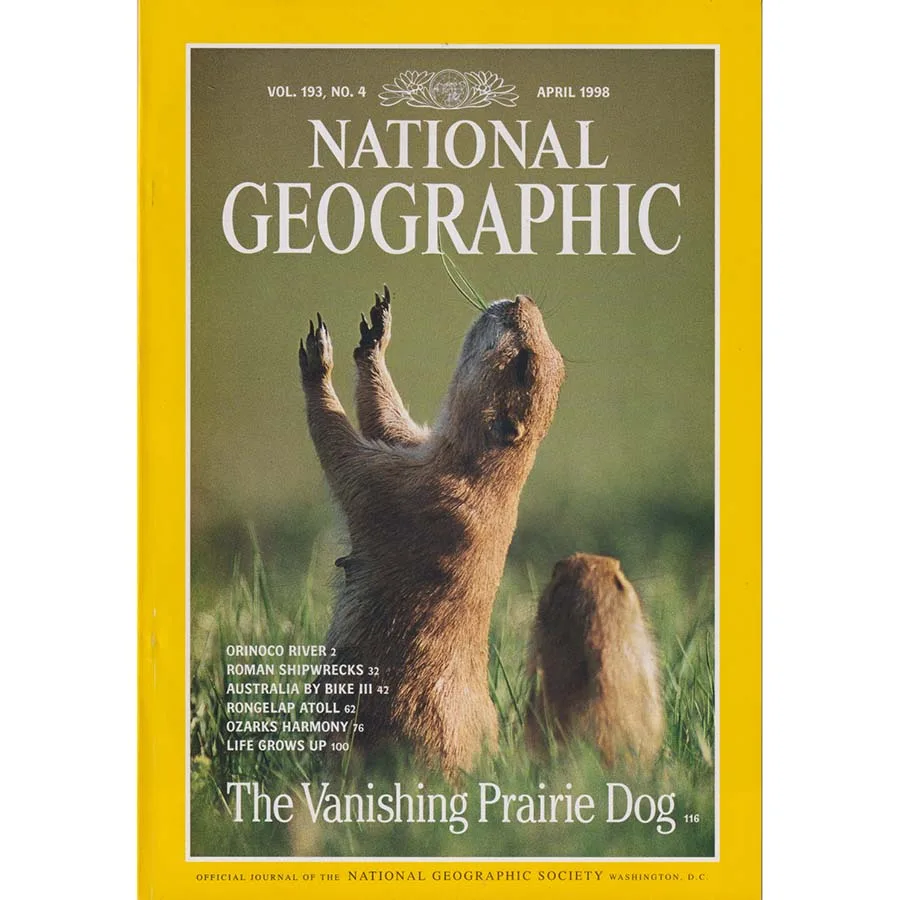
National Geographic, April 1998: the issue that politely clears its throat, raises two tiny paws to the heavens, and announces The Vanishing Prairie Dog like it’s delivering a TED Talk to the sky. The cover alone is a whole mood: one prairie dog standing upright in the grass, arms lifted in what can only be interpreted as either ecological despair or jazz hands for the end of an era. Behind it, another prairie dog lurks like a concerned friend thinking, “Don’t do it, mate. Not in front of the humans.”
And that’s the delicious irony of this particular yellow-bordered sermon: it’s about something small, squeaky, and adorable… and it’s also about the kind of large, squeaky, and less adorable thing humans do to landscapes when we decide we’d rather have neatness than nature. Prairie dogs, after all, are the original urban planners of the plains. They dig. They build. They keep the neighbourhood lively. And then we turn up and say, “Lovely community you’ve got there. Be a shame if someone… managed the land.”
Inside, you get the classic National Geographic buffet: earnest, lavish, and slightly hypnotic, like being gently lectured by a beautifully dressed librarian who has seen the world and is quietly disappointed in your recycling habits.
Here’s what’s waiting between the pages, all in peak late-90s “we can explain anything if we just add enough photos” confidence:
-
Orinoco River – a watery ribbon of drama and biodiversity, reminding you that some rivers aren’t just “nice views,” they’re entire universes with currents.
-
Roman shipwrecks – because nothing says “relaxing bedtime read” like imagining your luggage sinking in amphora form two thousand years ago.
-
Australia by bike (III) – the third instalment of someone cheerfully choosing hardship on purpose, proving that adventure is often just cardio with better scenery.
-
Rongelap Atoll – a place-name that sounds like a tropical cocktail and absolutely isn’t, bringing the heavier notes: history, consequences, and the awkward truth that paradise can be used like a laboratory.
-
Ozarks harmony – the soothing palate cleanser, where the landscape hums and people pretend modernity can be kept politely at the gate.
-
Life grows up – because Nat Geo never misses an opportunity to point out that evolution is basically a long series of terrible ideas that somehow worked.
But the prairie dog is the star, and not in a “cute mascot” way. More in a “tiny creature standing in front of the bulldozer of progress” way. The prairie dog is small enough to fit in your palm, yet apparently controversial enough to inspire full-scale human feelings: annoyance, nostalgia, righteousness, and that special kind of outrage reserved for animals that refuse to behave like decorative background.
And that’s why this issue is such a keeper: it’s not just nature porn (though the photography will absolutely ruin your ability to enjoy a normal field). It’s a snapshot of the 1990s conservation conscience—when we were starting to realise that “vanishing” isn’t a poetic adjective, it’s a receipt.
Condition: Good, which feels appropriate. Prairie dogs: not so good. The magazine: still here, still handsome, still quietly judging us from a used-book pile.
Perfect for anyone who loves:
-
wildlife stories where the “villain” is zoning,
-
history served damp and barnacle-encrusted,
-
travel writing powered by determination and blisters,
-
and a cover image that looks like a small rodent trying to summon rain, forgiveness, or at least a revised land-use policy.
Buy it from Crappy Old Books and enjoy the comforting ritual of flipping through a world that’s simultaneously huge, gorgeous, and alarmingly easy to misplace.
Keep browsing: See more National Geographic books Other books by National Geographic
